
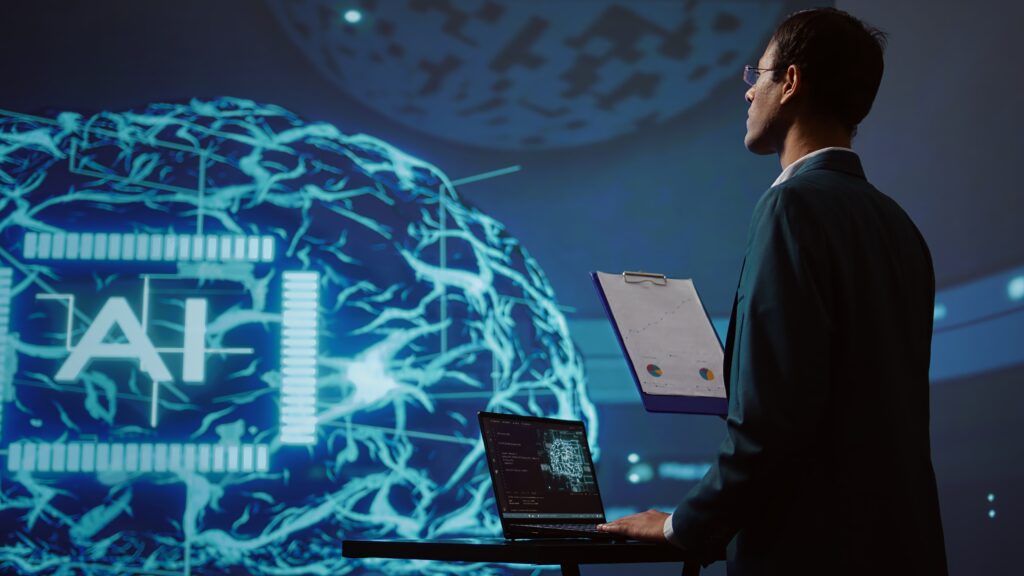
A Complete Beginner-Friendly Explanation
Artificial Intelligence (AI) works by enabling machines to learn from data, make decisions, and solve problems—almost the way humans do. Modern AI systems use advanced algorithms, massive datasets, and powerful hardware to understand patterns, improve over time, and perform tasks without being explicitly programmed for every step.
1. Data: The Fuel Behind AI
Every AI system begins with data. Images, text, videos, numbers, sensor information—all these become learning material for AI models.
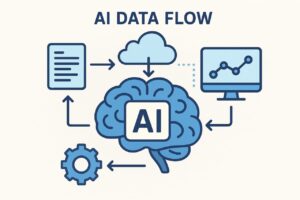
AI absorbs data the way humans learn from experience. The more data an AI model receives, the better it becomes at recognizing patterns.
2. Algorithms: The Mathematical Brain
After collecting data, AI uses algorithms—sets of mathematical rules—to process the information. Algorithms decide how the AI will:
Identify patterns
Detect relationships
Predict outcomes
Improve accuracy
Machine Learning algorithms such as decision trees, neural networks, and support vector machines help AI understand complex patterns.
3. Training: How AI Learns
AI learns through a process called training. Developers feed the model large amounts of labeled or unlabeled data. The model then adjusts itself again and again until it reduces the number of mistakes.
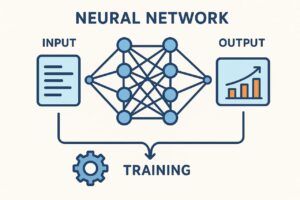
During training, the system tries millions of combinations to find the most accurate result.
4. Neural Networks: The Digital Brain Structure
Neural networks are inspired by the human brain. They contain layers:
Input layer
Hidden layers
Output layer
When data enters the network, each layer transforms it into more meaningful information.
Deep Learning, a popular field of AI, uses networks with dozens or hundreds of layers—called Deep Neural Networks.
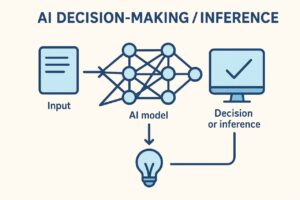
5. Inference: How AI Makes Decisions
Once trained, AI begins the inference phase, meaning it uses everything it learned to make predictions in real time.
Examples:
AI identifies a face from your photo
AI predicts what you will type next
AI recommends content on YouTube or Facebook
6. Feedback Loop: How AI Improves Itself
Modern AI systems continuously learn through feedback. The more real-world data they receive, the better they get.
For example:
A voice assistant improves as more people use it
Self-driving cars get better with more miles driven
This cycle of learning → predicting → improving makes AI smarter over time.
7. Modern AI Technologies Behind the Scenes
Today’s AI uses several powerful technologies:
● Natural Language Processing (NLP)
Helps machines understand human language
(Like ChatGPT, Google Translate)
● Computer Vision
Allows AI to understand images and videos
(Self-driving cars, medical imaging)
● Reinforcement Learning
AI learns by receiving rewards and punishments
(Used in robotics, game-playing AI like AlphaGo)
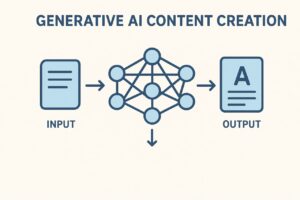
● Generative AI
Creates new content—text, images, videos, code
(Like DALL·E, Midjourney, ChatGPT)
8. Real-World Examples of How AI Works
AI is already working all around us:
Google Maps predicting traffic
Banks detecting fraud
YouTube recommending videos
Hospitals using AI for early disease detection
Factories using robots to automate production
AI doesn’t just work quietly—it is transforming entire industries.
9. The Future of AI
The future of AI includes:
Smarter personal assistants
Fully autonomous vehicles
AI doctors diagnosing diseases earlier
Advanced robotics in home and industry
AI-powered education systems personalized for every student
AI is evolving faster than ever, and its impact will continue to reshape the world.
Conclusion
AI works by combining data, algorithms, neural networks, and continuous learning. From simple pattern recognition to complex decision-making, AI systems are becoming more capable, powerful, and deeply integrated into our daily lives.
The more AI learns, the more it adapts—and the closer it gets to human-level understanding.