
Introduction
In 2025, Artificial Intelligence (AI) is not just a futuristic promise — it’s actively reshaping how education happens around the world. From customizing lessons for individual learners to automating administrative tasks, AI is penetrating classrooms, online learning, and institutional planning. The shift is profound, offering both opportunities and challenges.
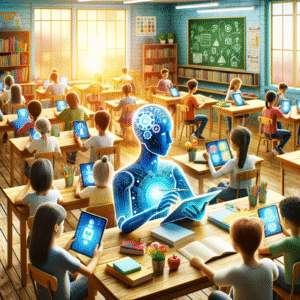
This article explores how AI is transforming education in 2025, covering key trends, benefits, drawbacks, and what lies ahead.
1. Personalized & Adaptive Learning
One of the most visible changes is the move from “one-size-fits-all” teaching to personalized learning paths. AI systems monitor a student’s pace, strengths, and weaknesses and adapt content accordingly.
Students now often see customized exercises, suggested reading, or extra practice in topics where they struggle.
AI tutors and intelligent tutoring systems offer real-time support, giving hints, asking follow-up questions, or offering alternative explanations.
In programming education, recent review research found that AI chatbots and tutoring systems improved feedback and learning outcomes, though overreliance remains a risk.
This approach helps each student move at their own pace, improving engagement and reducing frustration.
2. Reducing Teachers’ Load & Automating Tasks
AI is taking over many repetitive or time-consuming tasks so that teachers can focus more on high-impact interactions.

Automated grading and assessment: For quizzes, assignments, or short responses, AI can grade quickly and consistently, saving hours of work.
Content creation and lesson planning: AI tools can suggest lesson structures, generate quizzes, or even draft classroom activities.
Operational and administrative support: AI helps with scheduling, predictive enrolment, student monitoring dashboards, and even forecasting dropouts.
Educators often report that AI frees them from repetitive work so they can spend more time mentoring, coaching, or doing more creative teaching tasks.
3. New Learning Models & Modes
AI is driving new models of how and where learning happens.
Blended and hybrid learning: AI-driven online modules combined with in-person sessions.
Micro-learning and on-demand modules: Short, focused AI-driven lessons that students can take anytime.
Peer learning with AI mediation: Students collaborate, but AI can moderate discussions, highlight weak points, or suggest next steps.
Global classrooms: With AI translation and language support, students across geographies can join classes together.
AI as a co-teacher: In some advanced classrooms, AI agents work alongside human teachers—handling some tasks, suggesting differentiated pathways, and offering feedback.
4. Equity, Access & Bridging Gaps
AI holds promise to reduce inequalities—but it can also widen them if implemented poorly.
According to the Stanford AI Index, many countries now include K–12 computer science / AI education, but infrastructure gaps (electricity, internet) remain severe in some regions.
UNESCO notes that AI can help with access in underserved regions, but policy and resource constraints often lag behind.
In rural settings, research shows that while students see great potential in AI tutoring, lack of reliable connectivity, device access, and teacher training are major barriers.
Therefore, equal access to AI-powered education depends heavily on investment in infrastructure, teacher capacity, and inclusive design.
5. Challenges, Risks & Ethical Concerns
These transformations are exciting — but not without serious challenges.
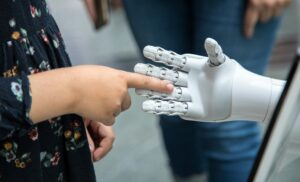
Overreliance and superficial learning: Students may lean on AI to get answers without internalizing concepts.
Bias, fairness & algorithmic discrimination: If AI models are trained on biased data, certain groups may be disadvantaged.
Data privacy and security: Student data is sensitive; misuse, leaks, or lack of transparency can undermine trust.
Teacher displacement fears & role ambiguity: Some worry AI will replace teachers. But most research suggests AI should assist, not replace human educators.
Academic integrity: Cheating and misuse of generative AI (like using LLMs to write essays) are concerns.
Explainability & transparency: Many AI systems are black boxes; educators should be able to understand why a recommendation or decision was made.
Training and capacity: Many teachers still feel unprepared to integrate AI effectively.
6. Real-world Examples & Innovations in 2025

Some schools are creating AI-powered private schools where lessons are partly delivered by AI and teachers act as mentors.
In many parts of the world, institutions are leveraging AI to boost student agency—allowing learners to choose paths, goals, and use AI as support.
AI projects targeting accessibility: e.g., converting textbooks into audio or interactive formats for visually impaired learners.
In programming education, integrating AI tools has shown promising improvements in feedback speed, though challenges remain.
7. What Should Educators & Institutions Do?
To harness AI’s benefits while managing risks, the following steps are vital:
Teacher training & AI literacy — equip educators with skills to design, supervise, and critique AI integration.
Ethical frameworks & governance — clear policies on data use, fairness, and accountability.
Hybrid design — AI should support human teachers, not replace them.
Transparent systems — allow inspection and explanation of AI behaviors.
Iterative evaluation — continuously monitor impact, adjust, fix biases, and improve.
Inclusive infrastructure investment — ensure access in underserved areas.
Design assignments differently — favor higher-order thinking, project-based, reflection, peer work over rote tasks.
Conclusion
In 2025, AI is deeply influencing education. It’s reshaping how students learn, how teachers teach, and how institutions operate. The potential is enormous: more personalized learning, better access, and reduced workloads.
But the risks—inequality, overdependence, bias, and losing the human element—are real. The future of education lies in balancing AI’s power with human wisdom, ensuring it becomes a tool that amplifies teaching and learning rather than replaces it.
If we get this right, the AI-augmented classroom of 2025 could become a model for more effective, fair, and inspiring education for all.