

What Is Artificial Intelligence?
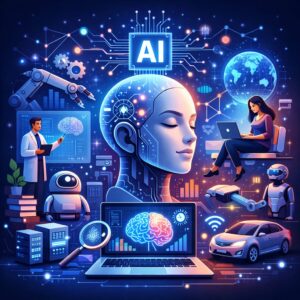
Artificial Intelligence (AI) is the ability of machines to perform tasks that normally require human intelligence. These tasks include learning from experience, understanding language, recognizing patterns, solving problems, and making decisions. AI is not about replacing humans—it is about empowering us with smarter tools that work faster and more accurately than ever before.
The Core Idea Behind AI
AI is built on the concept that computers can mimic the way humans think. Instead of just following fixed instructions, AI systems analyze data, improve automatically, and adapt to new situations. This is what makes AI different from traditional software.
Key Components of AI
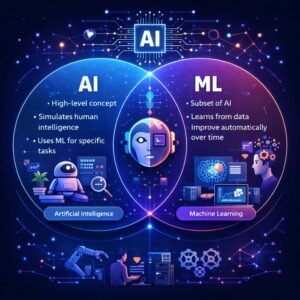
Here are the major branches that make AI work:
1. Machine Learning (ML)
ML enables computers to learn from data. The more data it receives, the better decisions it makes.
Example: Netflix suggesting movies based on what you watch.
2. Deep Learning
A powerful branch of ML based on neural networks (inspired by the human brain).
Example: Face recognition in smartphones.
3. Natural Language Processing (NLP)
AI that understands human language—speaking, writing, or texting.
Example: ChatGPT, Siri, Google Assistant.
4. Computer Vision
AI that can “see” and interpret images and videos.
Example: Self-driving cars detecting road signs.
Why AI Matters Today
AI is everywhere—sometimes without us realizing it. It makes our everyday life easier and business processes smarter.
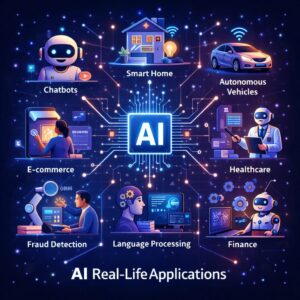
Real-life examples:
Healthcare: AI detects diseases earlier than doctors in some cases
Banking: Fraud detection and smarter customer support
Education: Personalized learning for every student
Business: Predicting customer needs
Transportation: Autonomous vehicles and optimized traffic
Benefits of Using AI
Faster decision-making
Saves time and human effort
Reduces mistakes
Large-scale automation
Opens the door to new industries and jobs
The Challenges of AI
AI also brings some concerns:
Job transformation
Data privacy
Bias in decision-making
Ethical usage
For AI to benefit everyone, these issues must be managed responsibly.
The Future of Artificial Intelligence
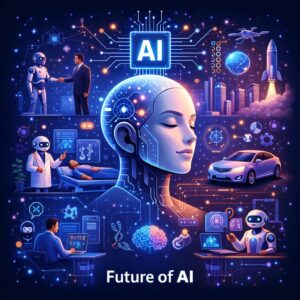
AI is still growing—and we’ve only seen the beginning.
In the coming years AI will:
Become part of every profession
Assist doctors, teachers, engineers, and creators
Power smarter robots
Improve science, medicine, environment & space exploration
AI will not replace humans—but people who use AI will replace people who don’t.
Final Thoughts
Artificial Intelligence is transforming the world by helping us work smarter—not harder. Anyone can learn and benefit from AI, whether they are a student, professional, or entrepreneur. This is the technology shaping the future, and now is the perfect time to understand it.
AI is shaping our future—let’s learn it wisely.