
Introduction
Artificial Intelligence (AI) has evolved from a niche technology into a global force shaping industries, communication, creativity, and even human decision-making. This rapid growth has sparked a heated debate: Can artificial intelligence replace humans? The answer is not as simple as “yes” or “no.” Instead, it depends on how we define “replace,” what roles we look at, and how society chooses to integrate AI in the future.
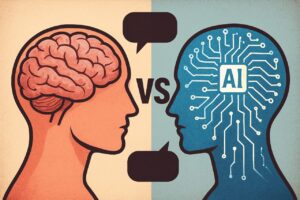
1. What AI Can Already Do Better Than Humans
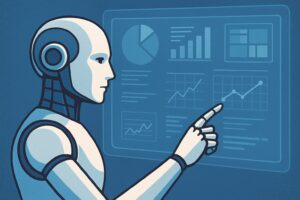
AI systems have reached remarkable levels of accuracy and speed in many areas:
a. Data Processing
AI can analyze millions of data points in seconds—a task impossible for humans.
From medical imaging to fraud detection, AI identifies patterns humans often miss.
b. Repetitive & Dangerous Tasks
Robots can operate in extreme temperatures, radiation zones, deep ocean sites, and outer space—places unsafe for humans.
c. Predictive Abilities
With vast data, AI can make predictions about weather, market trends, disease outbreaks, and customer behavior.
2. What Humans Still Do Better
Even with progress, AI struggles with several uniquely human qualities:
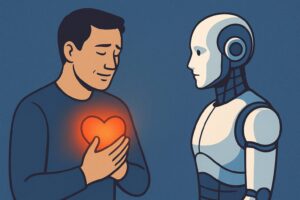
a. Emotional Intelligence
AI cannot feel emotions or understand subtle human experiences such as love, grief, guilt, kindness, or moral dilemmas.
b. Creativity With Depth
AI can generate images, music, or text—but it lacks lived experience.
Human creativity comes from childhood memories, society, culture, trauma, passion, and imagination—things AI does not possess.
c. Ethical Judgment
Only humans can decide what is morally acceptable.
AI follows rules; humans create them.
3. Jobs At Risk of Automation
While AI will not replace all humans, it will replace some roles—especially repetitive ones:
Data entry
Basic customer support
Telemarketing
Simple bookkeeping
Factory line jobs
Some transportation roles (self-driving trucks in the future)
A 2024 study from multiple tech institutes showed that 40–45% of tasks in common office jobs can be automated, but full human replacement is still far away.
4. Jobs That AI Cannot Replace Easily
Certain fields require empathy, complex judgment, or human presence:
Psychologists & counselors
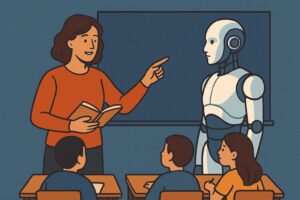
Teachers
Doctors (full replacement impossible, AI acts as a support tool)
Leaders & decision-makers
Artists with unique human expression
Skilled craftsmen
Lawyers who deal with ethics and emotional conflict
5. Will AI Become Self-Aware?
This is one of the most controversial questions.
Scientists disagree:
Some believe advanced AI might develop a form of “machine consciousness” but not human-like emotions.
Others argue true consciousness requires biology, not circuits.
Current AI models (including the most advanced in 2025) do not have self-awareness, desires, or free will.
6. The Real Future: Human + AI Collaboration
Instead of replacing humans, AI is more likely to:
✔ Make humans faster
✔ Reduce errors
✔ Handle boring tasks
✔ Support creativity
✔ Improve decision-making
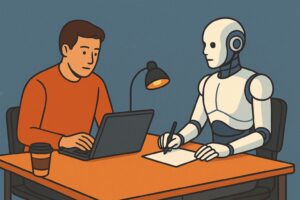
This creates a “hybrid future” where humans provide emotion, ethics, imagination, and leadership, while AI provides processing power, automation, and precision.
7. Can AI Replace Humans? (Debate Conclusion)
YES — In Some Tasks
AI can replace humans in repetitive, dangerous, or data-driven jobs.
NO — In Human Identity
AI cannot replace human emotions, morality, purpose, consciousness, or lived experience.
Balanced Conclusion
AI will not replace humans entirely—but humans who use AI will replace humans who don’t use AI.
The future belongs to those who learn to work alongside AI, not compete against it.