
Introduction
Artificial Intelligence (AI) as a formal field is relatively young, but its roots stretch back through centuries of philosophical and mathematical thought. In this article, we explore how AI emerged, key early milestones, and how it evolved into the powerful domain it is today.
Philosophical & Pre-20th Century Roots
The idea of intelligent machines or nonhuman reasoning traces back to antiquity. Philosophers have long speculated about automata, mechanical beings, and the nature of thinking.
In later centuries, the formalization of logic and mathematics (e.g. by Aristotle, Boole, Gödel) provided the tools necessary for thinking about symbolic reasoning and computation.
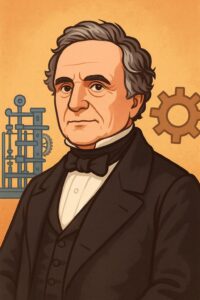
In the 19th century, Charles Babbage’s mechanical computing designs, and Ada Lovelace’s writings about using machines for calculation, laid groundwork for general-purpose computation.
While these earlier ideas were not “AI” in the strict sense, they set the intellectual foundation for thinking about machines that compute, reason, or “think.”
Mid-20th Century: The Birth of Modern AI
The starting point of AI as a scientific discipline is more clearly defined, and several key moments mark its birth.
Turing and the Question “Can Machines Think?”
In 1950, British mathematician and logician Alan Turing published a landmark paper “Computing Machinery and Intelligence”, in which he posed the provocative question: Can machines think?
Turing proposed what later became known as the Turing Test (or imitation game), as a method for evaluating whether a machine’s behavior is indistinguishable from a human’s in conversation.
In that work, Turing argued that a sufficiently capable digital computer, given enough memory, speed, and an appropriate program, might mimic human-like intelligence.
Coining “Artificial Intelligence” & Dartmouth Workshop (1956)
In 1955, a proposal was drafted by John McCarthy, Marvin Minsky, Nathaniel Rochester, and Claude Shannon to hold a summer research workshop on “artificial intelligence.”
That workshop was held in 1956 at Dartmouth College, and is generally accepted by historians as the official founding event of AI as a discipline.
At that workshop, the term “artificial intelligence” was used and popularized to describe the goal of creating machines that could simulate aspects of human intelligence.
Early AI Programs & Growth
Around the same period, Herbert Simon and Allen Newell developed the Logic Theorist (1955), considered among the first AI programs.
In 1958, John McCarthy created the Lisp programming language, which became a workhorse for AI research.
In 1959, Arthur Samuel coined the term “machine learning” in his work on a checkers program that improved by playing itself.
Also during the late 1950s and early 1960s, AI labs were established at institutions like MIT and CMU.
Progress, Challenges & “AI Winters”
Once AI had been launched, its development was not smooth. There were periods of high enthusiasm, disillusionment, and renewal.
Expansion and Early Hype
In the 1960s and 1970s, pioneering systems for natural language, robotics, vision, and expert systems were developed. For example, the program ELIZA (1966) mimicked dialog.
Researchers explored knowledge representation, heuristics, theorem provers, and rule-based systems.
Expectations were high: some predicted intelligent machines within a generation.
The First AI Winter
By the early 1970s, many of the promises had proven overly optimistic. Funding was cut or reduced. This period of reduced interest and investment is known as AI Winter.
Criticism and skepticism about progress contributed to funding cuts.
Revival and Second Winter
In the late 1970s and 1980s, expert systems became popular in business applications.
But by the late 1980s or early 1990s, the limitations again led to funding decline — the second AI Winter.
Modern Era & Deep Learning Breakthroughs
After the AI winters, research continued, and new methods gradually overcame earlier barriers.
Rediscovery of Neural Networks & Machine Learning
In the 1980s and 1990s, interest in neural networks, backpropagation, and statistical machine learning grew.
IBM’s Deep Blue defeated world chess champion Garry Kasparov in 1997 — a milestone in AI’s practical success.
Deep Learning, Big Data & Modern AI
In the 2000s and 2010s, massive data, powerful GPUs, and deep learning algorithms triggered a revolution.
In 2020, OpenAI’s GPT-3 became one of the largest and most powerful language models.
The 2020s have seen rapid advances in generative AI, multimodal models, and foundation models that can adapt to many tasks.

Summary & Interpretation
The 1956 Dartmouth Workshop is widely recognized as the beginning of modern AI.
However, its intellectual roots go much deeper — in logic, mathematics, and computation.
AI’s journey since 1956 has been filled with breakthroughs, pauses, and revivals.
Today, AI influences nearly every sector — from healthcare to education to space research.